
Lifequake peer groups
For people in the middle of a real shift, who do not want to carry it alone
Sometimes something in your life changes, or starts to. The usual way of moving through things stops working.
On the outside, you may still be functioning. Showing up. Performing. Holding things together.
Underneath, something feels different. Harder to name. Harder to sort through alone.
A Lifequake Peer Group offers a facilitated space to slow down, speak honestly, and make sense of what is changing alongside others who are also in motion.
This is one of those spaces.
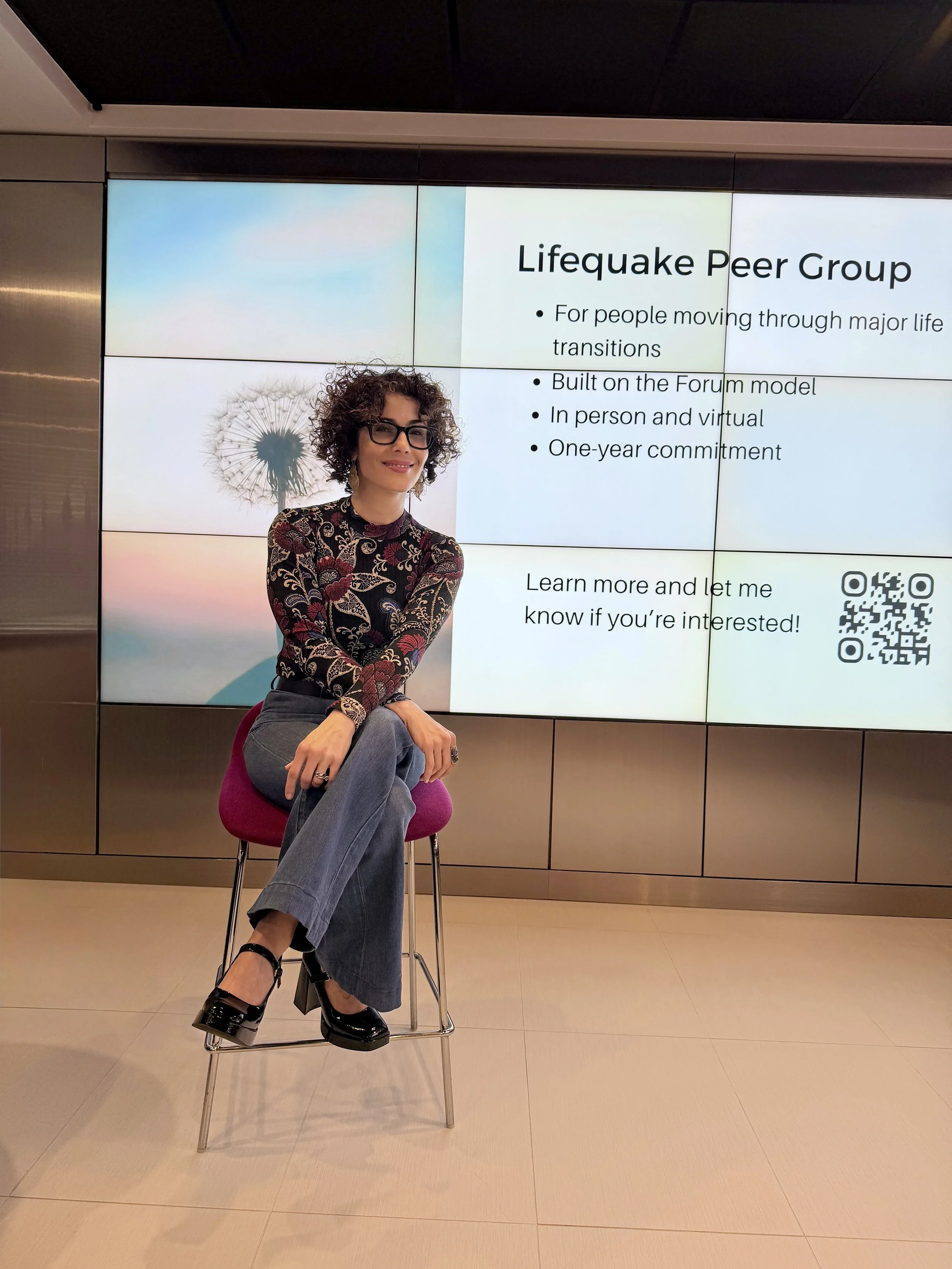
What is a lifequake
The term lifequake comes from Bruce Feiler’s book Life Is in the Transitions. It describes the kinds of disruptions or shifts that reshape how we understand our lives.
Sometimes it is visible. A role ends. A relationship shifts. Health changes. Work no longer fits the same way.
Other times, it is quieter. A growing sense that something is off. That the way you have been operating is no longer sustainable. That life is asking something different now, even if you do not yet know what that is.
A lifequake is not only the event itself. It is the process of making sense of who you are becoming because of it.

Who this is for
This is for people who are in the middle of something that matters and do not want to carry it alone.
Often, this includes changes in work, leadership, identity, health, relationships, family roles, or the quiet sense that something no longer fits.
You may not be looking for advice. You may not even be looking for answers.
But you can feel that something needs more space, more perspective, and a different kind of conversation than the ones you are having now.
This is especially for people who are willing to reflect honestly, listen deeply, and be part of a consistent group over time.
-
Why a peer group helps
We are living in a time of constant input and very little space to make sense of any of it.
People are holding more than they show. Functioning on the outside while carrying uncertainty, pressure, or change underneath.
These moments are hard to work through alone. Not because you lack insight, but because perspective has limits when it stays inside your own head. You loop. You second-guess. You move toward answers that do not quite hold.
A small, consistent peer group offers something different. You hear how others are making sense of what they are living through. You begin to recognize patterns, in them and in yourself. You stay with questions longer, without rushing to resolve them.
Over time, what felt unclear becomes more workable. Not necessarily resolved. But understood, and easier to move with.
-
Not advice. Perspective.
This is not a space for advice, fixing, or problem-solving.
Instead, people speak from their own experience. They share how they see something, how they have moved through it, or how they are making sense of it in real time.
That shift changes the quality of the conversation. It creates more room for reflection and allows you to hear your own situation differently without being told what to do.
Think of it as a personal board of directors.
Not there to advise you, but to help you see more clearly, think more honestly, and stay connected to what matters as things shift.

What a session feels like
No two meetings are exactly the same, but there is a clear rhythm.
People bring what they are actually living through. Not a polished version. The real version.
The group listens, reflects, and shares perspective. The structure creates enough focus to stay with what matters, while leaving room for nuance and what is not yet resolved.
Insight often comes indirectly. Through something someone else says. Through hearing your own words out loud. Through recognizing something you had not fully seen before.
-
Why facilitation matters
Peer groups, on their own, can be helpful. But not all groups create the same kind of experience.
A Lifequake Peer Group is a facilitated space. The structure creates the conditions for trust, depth, and psychological safety. It allows people to speak honestly without the conversation drifting or staying at the surface.
Facilitation helps the group stay with what is real, even when it is unclear or uncomfortable.
The facilitator holds the structure. The value comes from the group.

Program details
Start with the application
The first step is not a commitment. It is a way to begin the conversation and explore whether a Lifequake Peer Group may be the right fit.